
He ran the Athens Marathon so you wouldn’t have to – and hallucinated Cliff Young 35km in – here Bangalow’s Angus Thurgate shares his experience of running up that hill.
Recently I learned that my partner has aphantasia. The 14-hour economy class flight produced the unexpected information that she could not voluntarily visualise mental images. She couldn’t see something in her mind’s eye – and that this condition was called aphantasia.
I, on the other hand (or seat 17B in this specific circumstance), have quite the opposite condition. I can visualise things to such a vivid and spectacular degree in my mind’s eye that when I lay eyes on the actual thing, the reality can be somewhat disappointing.
When my Year 11 Ancient History teacher, Mr Rawlings, told the class all those years ago of his recent trip to Greece, he recounted sitting on some ancient marble in the ruins of the agora at the foot of the Acropolis – the agora being the meeting place of the ancient Athenian assembly. He then added casually, “It could have been almost the exact spot where the messenger Pheidippides delivered his famous line, ‘Nenikekamen!’ or ‘Rejoice! We conquer!’ before collapsing and dying.”
I was enraptured. My teenage brain exploded. I could see it so clearly in my mind’s eye that I almost dropped dead myself.
He was referring, of course, to the legend of Pheidippides, who ran the 26 miles (42 km) in 490 BCE from the battlefield of Marathon to Athens to deliver the improbable news that the vastly outnumbered Athenian army had comprehensively defeated the invading Persians.
The image never left me.
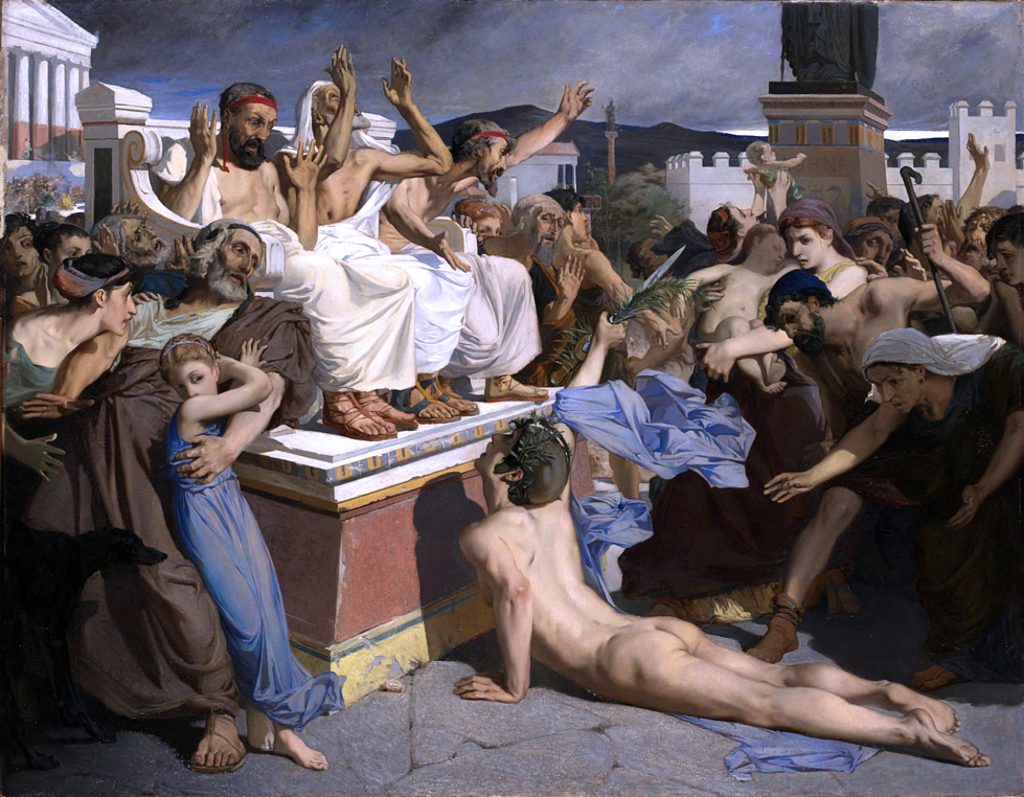
Fast-forward now 2,515 years to the relatively small space around seats 17A and 17B in an aircraft hurtling towards Greece, where your correspondent (me) is not only discovering what aphantasia is, but fairly soon will be wishing that he had it as well. Because we were flying to Athens so that I could run where Pheidippides ran.
I was competing in the Athens Marathon.
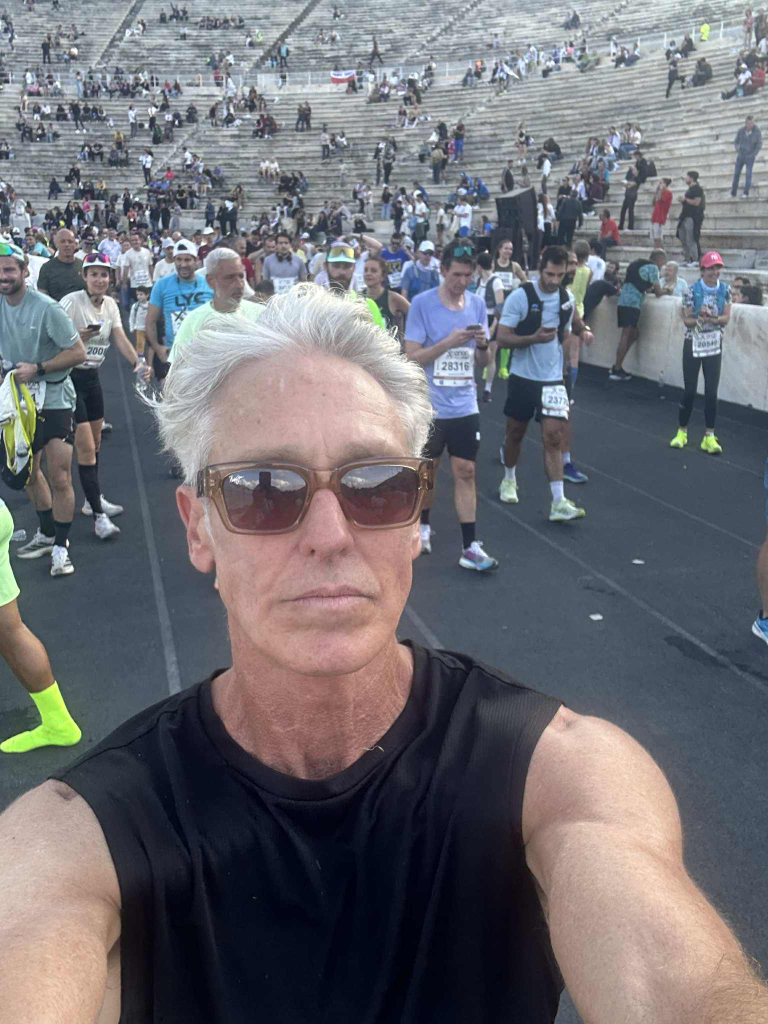
The start was incredibly exciting. I had picked up my bib (number 3852) two days previously from a stadium used for the 2004 Athens Olympics. It also contained a Marathon Expo – a huge, neon-lit, multi-storey frenzy of stalls from sporting companies with names referencing Greek gods. Consequently, and for a mere couple of hundred dollars, I had purchased (and was wearing) special marathon socks, compression sleeves for calves, knees and thighs, and a stupid marathon hat. I also had an impressive array of energy gels, electrolyte replacement gels, and a variety of salves, ointments and unguents to promote rapid muscle recovery post-event.
It was exhilarating to be one of about 25,000 participants from around the world lifting our hands in unison towards the overhead drone cameras and yelling (as instructed, in Greek and English) for world peace. There was a muffled explosion (that was the starting gun — I was a fair way back), and we shuffled forward. Five minutes later, I crossed the actual starting line and we were off.
Of the race itself I shall say little. For a running race, it was an emotional roller coaster. I can attest that the so-called ‘runner’s high’ is real. The endorphin release from intense exercise is euphoric.
It does not, however, last for 42 km.
The first 10 km were great. I loped along happily, sucking down energy gels and bright blue electrolyte replacement drinks.
It was my lower extremities that started shutting down first. Appropriately, perhaps, the Achilles area – then my calves got in on the act, and the whole nightmare moved north.
Large flags were posted every five kilometres indicating the distance completed. I noticed that the appearance of these flags slowed whilst the muscle pain increased.
Thirty Ks in and my resolve to keep running – no walking under any circumstances – had found a loophole. I overcame an urgent desire to throw myself in the bushes and weep only by having murderous thoughts about Mr Rawlings. I forced myself to hobble on.
I realise now it was a hallucination, but I swear I saw God at 35 kms. And he looked like Cliff Young.
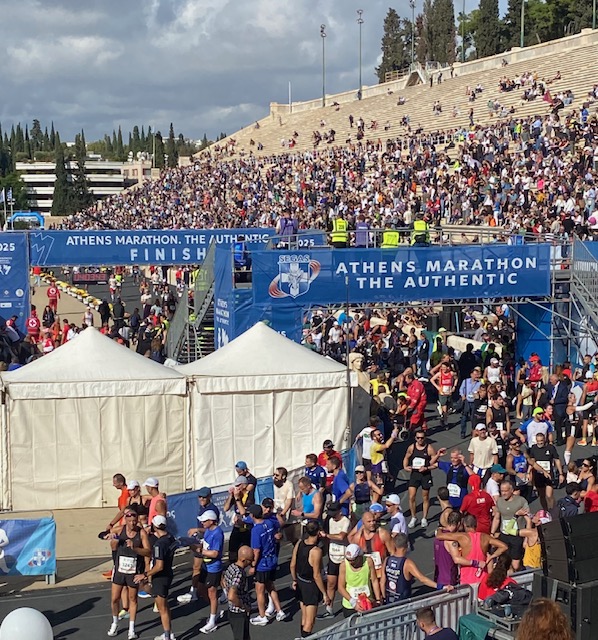
Whoever or whatever it was, it worked. The crowds lining the final 7 km got louder. I knew they weren’t there for me, but I didn’t care. My wife was – and that was all that mattered.
Pheidippides is my hero.
Turns out he probably didn’t run the marathon after all. He did something far more impressive – he ran from Athens to Sparta before the battle to request Sparta’s help (they declined – religious festival, don’t you know), then back to Athens to deliver the bad news (about 490 km).
On that return trip, so the legend goes, Pheidippides encountered the god Pan on Mount Parthenium, who told him to ask the Athenians why they paid him no attention – he’d helped them before and possibly could be of assistance in the upcoming conflict. The Athenians believed Pheidippides and did indeed build a shrine to Pan under the Acropolis – after all, they did spectacularly repel the invaders.
I’ve always associated Pan with wind instruments and debauchery, but never in my wildest mental imaginings did he look anything like Cliff Young.
… I’m thinking now that Cliff, who ran 875 km from Sydney to Melbourne, was a modern-day Pheidippides, and since I have acquired selective aphantasia, I shall salute them both– from the sidelines.
Note
For those too young to remember, Cliff Young was a 61-year-old vegetarian potato farmer who surprised the world (especially the ultramarathon community) by winning the inaugural Sydney to Melbourne race, essentially by not sleeping. The quintessential human tortoise in a field of hares.
Feature image Angus writing this story on Hydro near Leonard Cohen’s former domicile Photo Sue Franklin (participant in the recent Bangalow Herald photography for news workshop!)