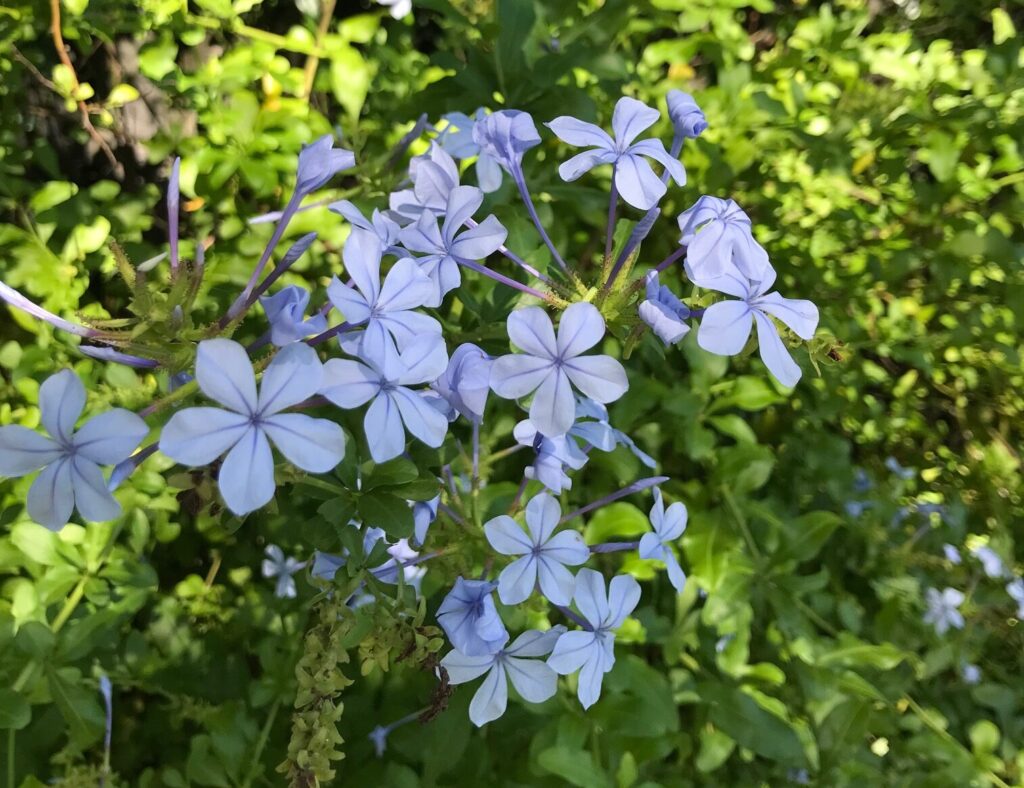
It’s funny the way that plants and landscapes surface in books sometimes and remain strong memories of place. Patrick White, writing from the eastern suburbs of Sydney, often remarked upon “the cascading blue blossoms of plumbago growing all unruly in neglected gardens over fences and outbuilding roofs.” From my garden in Melbourne (where it isn’t grown much), I wondered about it, as I love blue flowers, so I looked it up. Now, whenever I see it around here in old gardens, I am reminded of this Nobel Prize-winning author’s gardens.
I learnt that it is a hardy, old-fashioned plant, much planted in the early 1900s. It is sometimes known as a sky flower or even leadwort and it comes from South Africa but doesn’t thrive in Melbourne’s climate. Incidentally, I also found that ‘leadwort’ referred to the perceived usefulness of plumbago as a cure for lead poisoning, which was all too common in the past. Auriculata, as you may guess, refers to the leaf shape, which was compared to the human external ear!
Part of the family Plumbaginaceae, a genus of twenty-three known species, it is usually sky blue with a small variation in depth of colour and sometimes white (P. auriculata). P. auriculata originates in South Africa, although there is another very similar plant called Ceratostigma plumbaginoides from Western China with a totally different taxonomy!
Plumbago can be encouraged over fences and solid structures, trained into a standard specimen, or trimmed and pegged down to cover rock gardens and slopes. Left unchecked, it can become up to three metres tall and wide. Regular pruning will keep it compact, but some people develop skin reactions to the sap, so take care.
In full sun, it flowers profusely on and off during warm months, is drought-hardy, and has no pests or diseases unless it is stressed, and then sometimes will have a little mealy bug. It is susceptible to root rot, so it needs good drainage. Butterflies love it, especially as it flowers so profusely, and in the Butterfly House on Bribie Island (well worth a visit!), it is one of the main plantings.
Propagation is by seed or cuttings; the latter produces true-to-form colour best and, of course, is much quicker. Some good nurseries stock it, but it is easy to propagate, and I think that it deserves a spot in more new gardens.