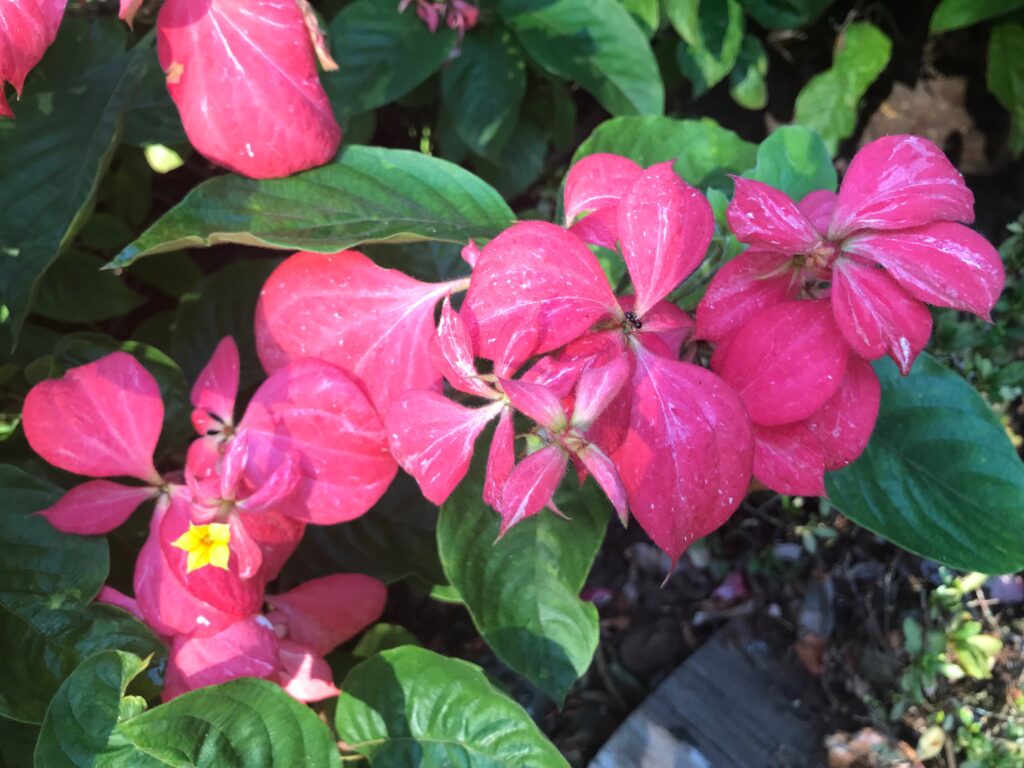
Partly because of our crazy weather, there is little flowering near me at present, but I pass a Mussaenda in a neighbour’s garden every morning and marvel at the fact that it is ALWAYS covered in blossom. Because it is on a slope (good drainage) and in full sun, north-facing, this is clearly a plant worth using more often.
Mussaenda can have large pink, white, or red bracts (these look like petals but are not) and the actual small flower is usually yellow. Butterflies love them! M. erythrophylla is originally from West Africa and the white varieties are mostly thought to be northern Indian in origin, but because there are so many hybrids and cultivars, opinions vary on this.
Mussaenda is a member of the Rubiaceae family, which includes gardenias, ixoras, pentas, and coffee, which is a bit surprising. Another instance of botanical groupings of plants that don’t appear to be similar.
The Mussaenda pictured above is a hybrid, and it might be worth saying a little about hybrids because we can all get a bit confused about what is meant by ‘hybrid’ and ‘cultivar’.
In brief, a cultivar is deliberately created through controlled breeding. This may be to improve or combine features such as longer flowering, disease resistance, or size alteration, or to diminish those features and improve adaptability. They retain the desired characteristics when propagated by division, cuttings, grafting, offsets, tissue culture, or careful seed selection, although this last method has a higher degree of variation than others.
Hybrids, by comparison, are accidental or wild changes in the parent plants that may be a result of climatic conditions or a reaction to environmental changes. Sometimes these hybrids are dramatically different and can be much sought after, leading of course to horticultural enthusiasts cultivating them for commercial rewards! These ‘wild’ hybrids are often more vigorous because of greater genetic variability; have more flowers, grow faster and larger, and demonstrate again the desirability of mongrel breeds.
Suited to our subtropical area, they tolerate a large range of soils and thrive in full sun or part shade and, like most plants, require good drainage, appreciate mulching and soil improvement, but don’t need fertilisers. They respond well to pruning so that their natural dimensions of two metres high and two metres wide can be reduced to suit your garden.
The blooms are lovely in mixed flower arrangements and add that touch of colour when not much else is enlivening our gardens. Mussaenda has just joined my list of plants to fit into my garden – somewhere.
Carole Gamble