Tricia Shantz has followed the success of her first book, Neverland – a social history tracing the arrival and cultural impact on Byron Bay of American and Australian surfers in the 1960s – with Musicland: When the music came to Byron 1974 to 1995. Here, she speaks with Christobel Munson about what she discovered from her fascinating interviews, primarily with musicians and promoters, to write her new book tracing the early explosion of music in the hills around the shire. Included here are some juicy quotes from the book.
“We all know the stories of the cedar cutters in our shire, the dairy farms, the meatworks in Byron Bay, and the mining of the beaches. I wanted to tell the story of what happened after these industries finished, and what took their place,” says Tricia.
“In the mid to late ’70s the music scene in Australia exploded,” she writes. “The stultifying conservative 1950s gave way to the swinging sixties and opened the door for Australian music in the 1970s and ’80s. It was the most influential time in Australian music. A wave of bands formed, touring by road the east coast of Australia from Melbourne to Sydney to Brisbane. Many of them stopped in at Byron Bay, Bangalow and Lismore, including the most notable Australian bands of that era.”
Music had been happening for decades before the first annual Byron Bay Bluesfest in 1990. It erupted as outdoor music festivals on various rundown dairy farms like Fowlers Lane, in the Norco Piggery (recycled as the Arts Factory), at Music Farm Studio, and at other key venues like the Bangalow Bowlo.
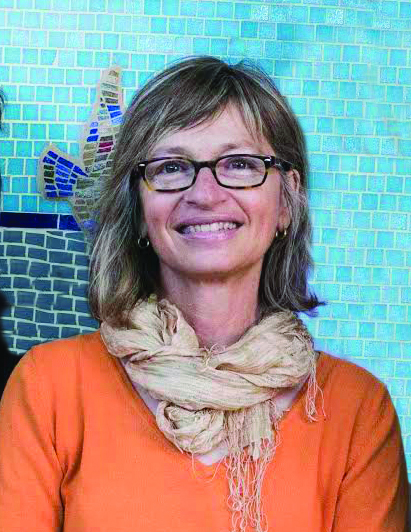
“Musicland is the follow-on to Neverland,” Tricia explains. “Neverland finished with the story of American surfer-musician, Dan Doeppel, who came to Australia in 1967 in a band called The Nutwood Rug. Dan came to Byron Bay and bought the old Norco Piggery in 1974, with the dream to turn it into the Arts Factory.”
In 1976, Melbourne musician Garry Deutsher created Music Farm Studio on an old dairy farm in Coorabell. Tricia and her partner, surfing legend Rusty Miller, lived next door to the studio for 33 years. “All the big names came here to Byron in the 1970s and 1980s: Midnight Oil, Cold Chisel, The Angels, Australian Crawl, Mental as Anything, Redgum, Goanna, Richard Clapton, Mondo Rock, Divinyls, Split Enz, Rose Tattoo, Kevin Borich, Eurogliders – and so many more.” These bands either recorded at the Music Farm and/or played at the Arts Factory.
From the 1980s, many other musicians also recorded at Music Farm, including Olivia Newton-John, Yothu Yindi, Mental as Anything and Jimmy Barnes (in Cold Chisel). Next month, Music Farm will have been operating as a working music studio for 50 years. “This is an amazing testament to all the people who were involved in building the studio, and the musicians who have recorded there. I wanted to acknowledge this, and pay homage to it,” says Tricia.
“Because I know many of the people involved in the making of the Arts Factory and Music Farm, I had access to their stories. However, for big, known bands that recorded at Music Farm, I relied on many musicians to share other musicians’ contacts. Rob Hirst, from Midnight Oil, was the first of 80 interviews for this book. Rob, who very sadly died recently, was most generous in assisting me with the phone numbers or emails of his musician friends. This opened doors for me. I am so appreciative of his generosity of spirit towards my book.”
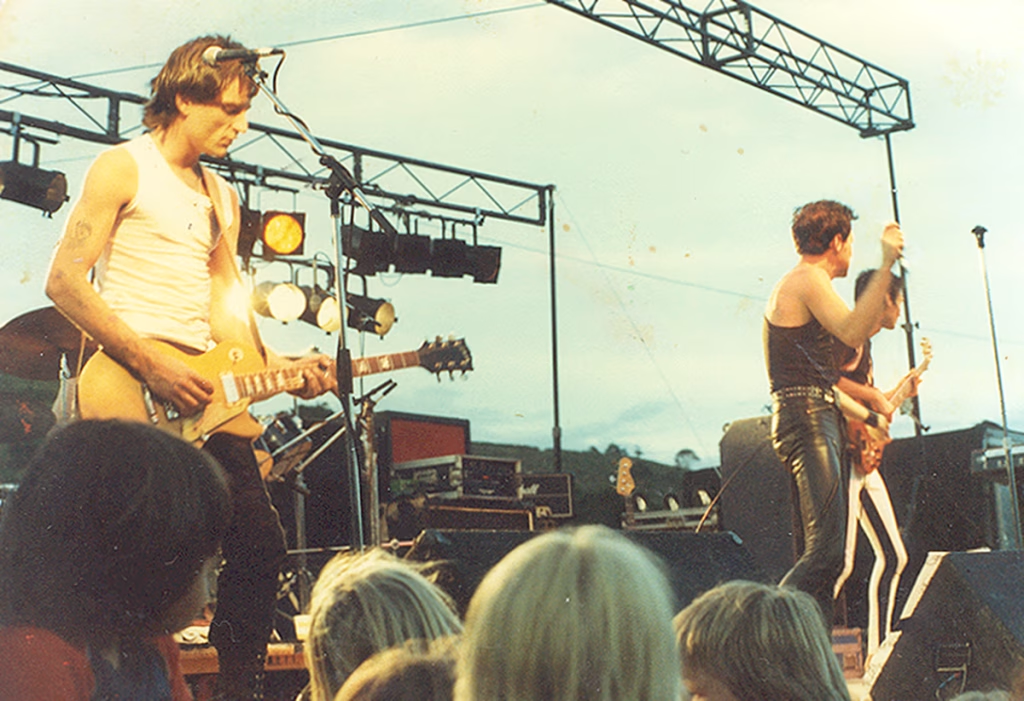
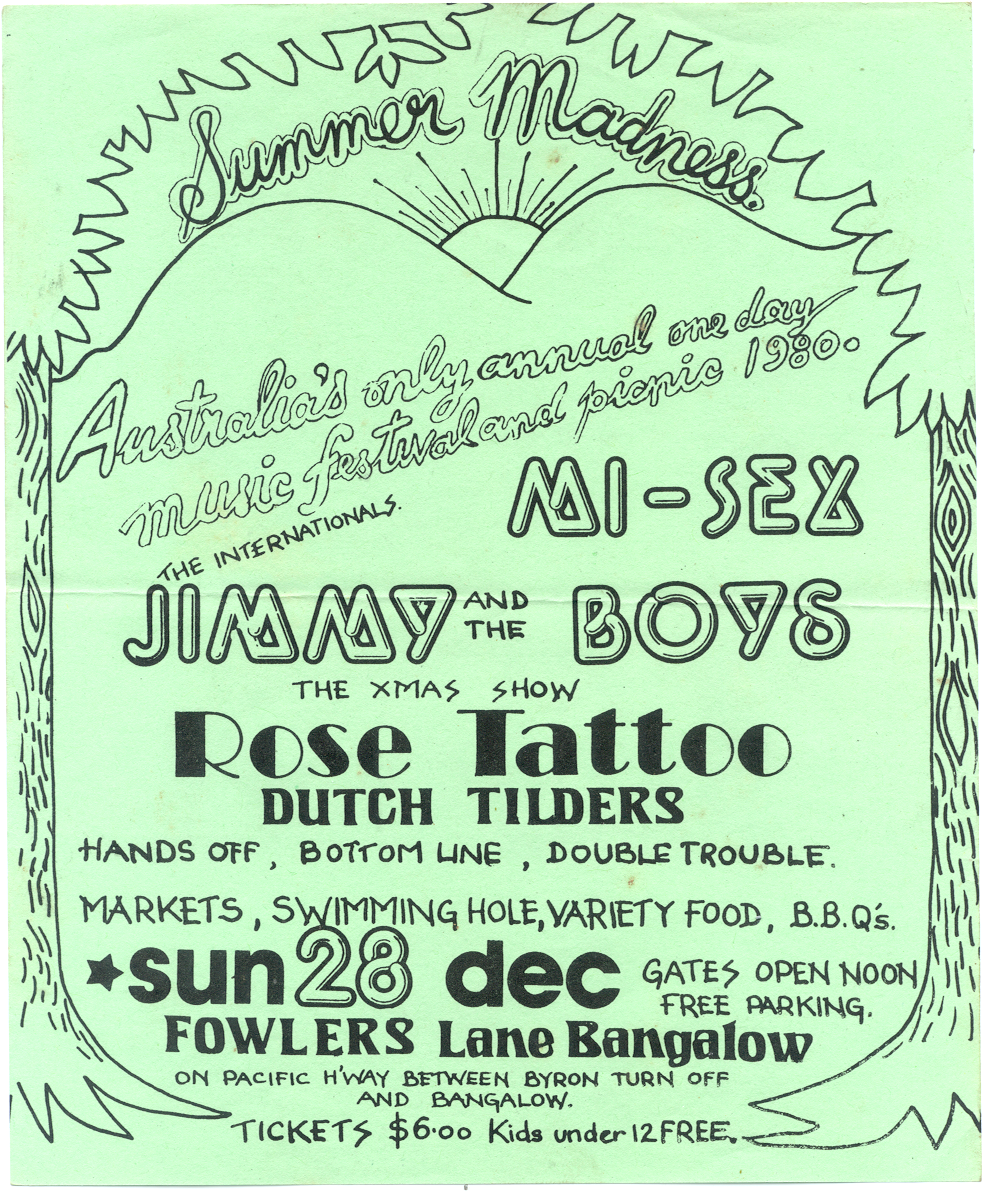
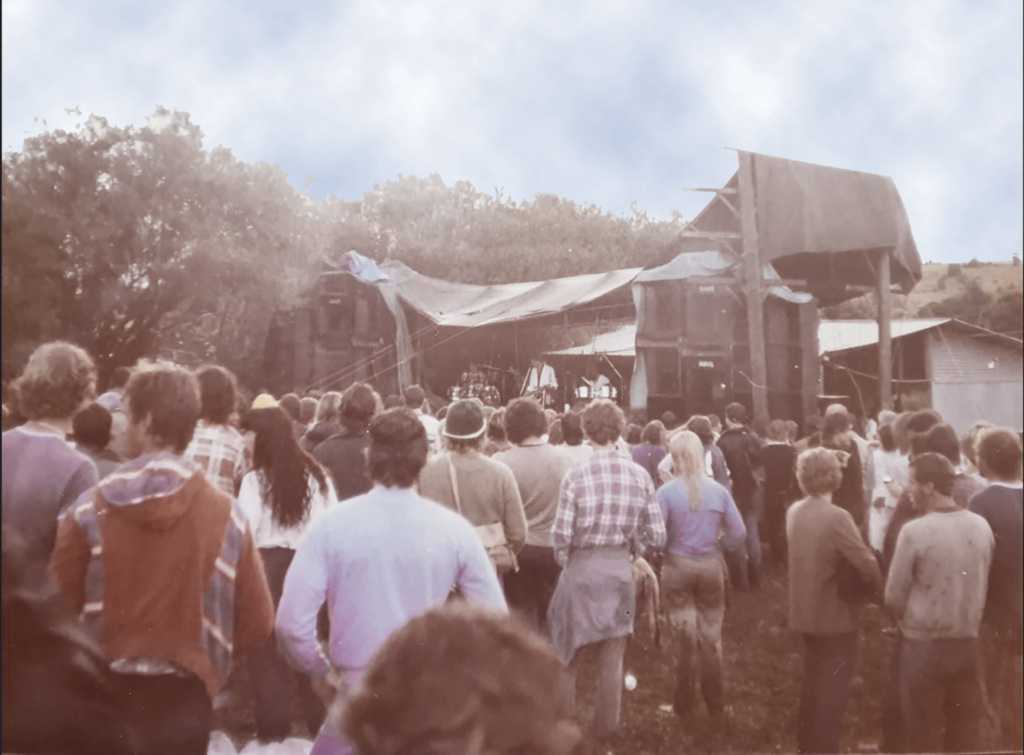 Venues could be “make do”. Between 1976 and 1982, concerts were held on the 113-acre Fowlers Lane former dairy property of Harry Fowler. Many were organised by music promoter Roger Danne, sometimes with his business partner Denni Scott. Well-known Australian music promoter Michael Chugg, who knew Roger Danne in Sydney, was also involved.
In her book, Tricia quotes Roger Danne: “I was living at Music Farm Studios, and Chugg was the promoter from Sydney who would bring the bands. I did Fowlers Lane with him for two years. Split Enz played at Fowlers Lane. They were fantastic. They played on the back of a semi-trailer with no roof. It was a full moon, and when Tim Finn sang: ‘I hope I never, I hope I never have to cry again’, it was unbelievable. It was one of those moments – one of the best, ever.” In April, Split Enz was due to perform at the now cancelled Bluesfest.
 “There are glimmers that I remember about the Split Enz concert at Music Farm in 1979,” recollects Mark Pope, who promoted that event. “There are two things I remember about the concert. I remember speaking to Garry Deutsher about it and the table-top semi-trailer that was the stage that they played on. I don’t know how we rigged the lights because there was no stage or roof. I think we might have had close to 1500 or 2000 people. Tickets were around $5 a head.
There was no security. We made it up as we went along. I was staying in a caravan near where the stage was set up. I woke up the next morning after the concert. I had my thongs on, stepped out of the caravan, took two steps, and literally between my toes was a freshly made cow turd. I still remember to this day, this warm shit coming up between my toes.” Later, Mark Pope promoted INXS and Cold Chisel.
Roger Danne recalled a night when Cold Chisel played at the Bangalow Bowlo, which holds around 300 people. “The night Cold Chisel played there were 500 people. The place was packed; people were outside who couldn’t get in. Someone picked up a chair and smashed the glass window in the foyer. We had to stop the show. Jimmy Barnes came down and said, ‘Wake up to yourself!’ He sang acapella through the broken window for the people who couldn’t get in to see the show.”
Tricia also quotes INXS guitarist Tim Farriss, who recalls playing at the Bowlo in September 1980. “That would have been when we first became INXS, having only just changed our name from the Farriss Brothers. It would have been the first time we played the North Coast. It was a really great crowd and audience.”
Musician Barry Ferrier continues the recollections. “Innerspring was a five-piece band with two road crews when it included Michael Barnes. We were working solidly five nights a week. We supported Cold Chisel, who were the last gig at the Bowlo. Jimmy went out on the green and the girls followed him. It wasn’t just the greens, it was the door also. People were having sex under the pool table. It was a wild gig. It was packed.”
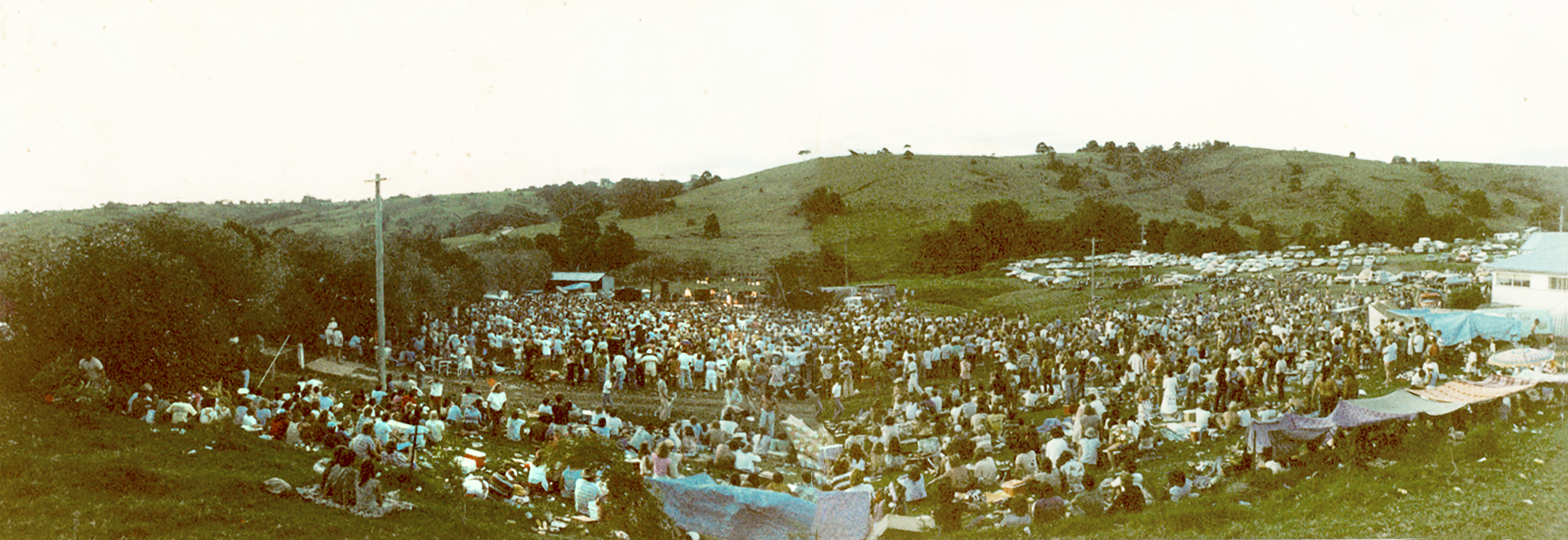
Tricia moved to the area in the early 1980s. Among her many other endeavours – ranging from social planning work, researching for a town planning company, 15 years in local government and 21 years teaching social science at Southern Cross University – she worked for a year researching and interviewing people on the history, development and activism on the Byron Shire coastline. “Again, it’s documenting the history of our place, and the people who have been cultural shapeshifters. We live in an area with such rich contemporary history that is not really documented. I feel compelled to explain how and why Byron Shire is what it is today: what, and who made it this way.”
Musicland: When the Music Came to Byron 1974 to 1995 will be launched in Byron Bay in August. Email triciashantz11@gmail.com to pre-order.
Feature image: New Zealand’s Mi-Sex playing at Fowlers Lane in the 70s