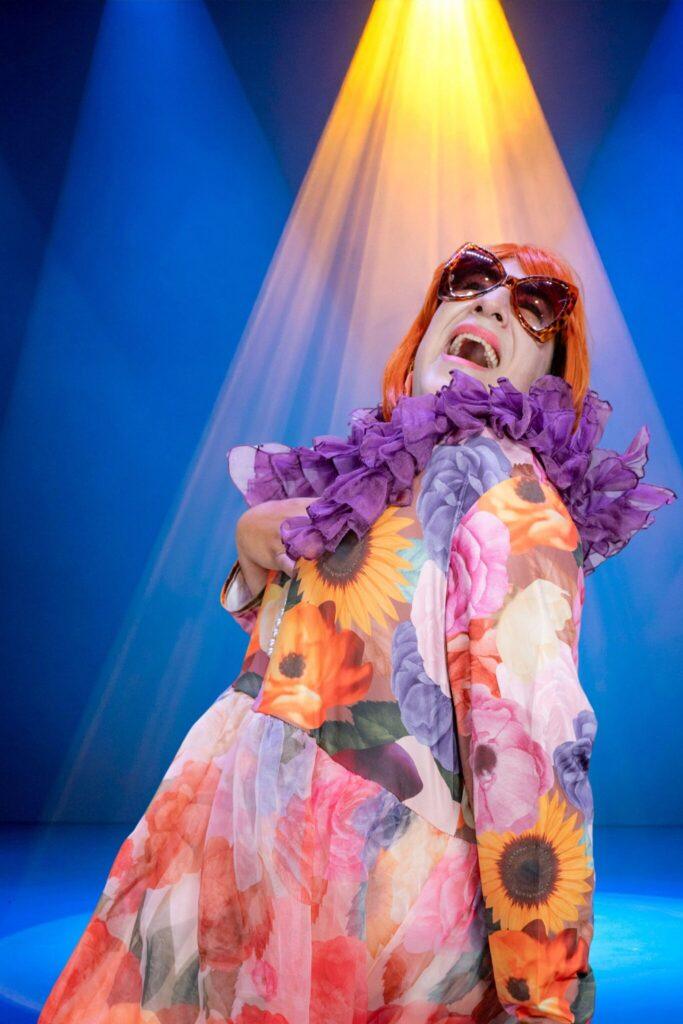
Gabby Le Brun meets Michael Sharmon, the playwright giving the Bard a new twist.
MC: “You can’t change the world with sequins.”
Beatrice: “But the second those lights hit me, I wasn’t a punchline anymore. I wasn’t the freak at the back of the classroom – I was someone.”
A Midsummer Night’s Queen (MNQ) is a musical written by Bangalow-based Michael Sharmon and directed by Kylie Faud for the Drill Hall Theatre Company – “a vibrant reimagining of Shakespeare’s Much Ado About Nothing through an LGBTQIA+ lens”. The exchange above, between the MC and lead character Beatrice, speaks to the pain of marginalisation, and the power of finding your voice. But you don’t have to be queer for these lines to resonate. At the heart of Michael’s work is the desire to build common ground between people.
Michael was born in Melbourne, but when he was five his family moved to a small regional town in Queensland. From his perspective, it was less a tree change, more a hostage situation. He paints the town in terms of “the stinky pool” and the funky gym mats. In a vicious act of racism, Michael’s Indian father was spat on in the street. It was as if the “brittleness and harshness of the landscape seeped into the character of the community, and parched any softness or tenderness right out of them”, he says.
Michael is the antithesis of this. His manner does not reflect any of the brutal bigotry and violence he’s been subjected to throughout his life.
Tucked into a convivial corner of Bangalow’s Tuck Shop, where we do the interview, Michael’s presence is like a hug for the nervous system. His optimism is contagious. His eyes light up; he’s generous with laughter and compliments. “Oh, she’s amazing,” he says of a mutual acquaintance. You know you can trust that Michael would advocate for you in rooms you’re not in.
“It’s hard to find the strength, when you don’t feel you fit in,” the MC in MNQ sings.
Michael says he “hated sport” and yet found himself in a sports-mad town with no community drama clubs or theatre companies. The pain cracks his voice as he describes this period. He managed to escape at 15 by attending high school in Brisbane, where he found his people at La Boite Roundhouse Theatre. But he credits that small town as “where my imagination came from – out of necessity”.
When he was eight, Michael composed his first musical number, featuring the lines:
“Just look at what computers have done to our lives.
They’ve changed our hearts, they’ve changed our wives.”
I laugh and ask if there was any political subtext, but he says no: “It just rhymed well. I didn’t think that deeply about it.” I blush, remembering how my sister and I (aged eight and 10) rewrote the lyrics to Sam Fox’s Touch Me. Michael is delighted by the confession. That’s what he does – he dissipates shame with representation, compassion and advocacy.
A Midsummer Night’s Queen represents these qualities in action on a grand scale. While it is a funny musical romp with exquisitely rhyming lyrics – and sequins – there’s also an unashamedly political undercurrent. The setting – Lismore’s Tropical Fruits New Year’s Eve Party, the “second largest Pride gathering in Australia” – is a declaration of cultural significance. On a personal level, it’s a tribute to a place where Michael has
found joy and belonging over the years. In a beautiful synchronicity, Michael and two other cast members, including Bangalow local Tia Nelson, performed an MNQ medley to much acclaim at Tropical Fruits at the end of 2025.
Michael was already an accomplished singer and actor when he returned to Melbourne to pursue a professional acting career, but was advised by Actors Equity that he needed to add dance to his skillset. At Tony Bartuccio’s dance studio, he found himself – a novice – among highly technical and experienced dancers. It was intimidating, but he was determined. He loved the feeling that dance gave him, and the “grace and strength in my body”.
Safe within the dance community, Michael publicly came out. But the professional acting world wasn’t as welcoming for a gay man auditioning for roles, and he was advised to “butch up”. He deepened his voice and straightened his gait.
Fundamentally, acting is shape-shifting. But Michael finds parts of himself in each role. In MNQ, he identifies most with the character he plays: Bertie/Beatrice/Miss B, who has the drive and courage to face things head on. He acknowledges that the “witty, battle-hardened, glamorous drag artist” is a lot more “out there” than he is, but he’s leaning into her exuberance. Still, he’s determined not to turn her into a caricature. For authenticity, Michael draws on drag queen mentors from the 90s Melbourne scene at Three Faces nightclub. MNQ reflects his strong sense of social justice and advocacy for their community.
The 1993 film Philadelphia, starring Tom Hanks as lawyer Andrew Beckett, was considered revolutionary for being the first major Hollywood film to directly address discrimination and homophobia, and make the AIDS crisis personal. MNQ also makes the political personal. Beatrice’s love interest, Benedick, lives with HIV.
In the number A Different Kind of Man, Benedick sings: “There’s a rainbow with shades of grey,That most of us don’t want to see.”
Michael has known many people like Benedick – those in whom the bright lights and sequins mask silent, taboo battles.
His own life has not been immune from private suffering. His early acting trajectory came to a halt after he was sexually assaulted by a theatre director. He walked away from the industry and went to work in retail. By 2007, he was working full time at a bank, until his mum – living in The Channon – suggested he take a break and visit. He resigned, enrolled in drama at the Northern Rivers Conservatorium in Lismore, and the path back began.
He later worked in Hong Kong as an actor and director for 15 years. In 2016, he performed his musical Auditions at the Edinburgh Festival, and it was sold out by the end of the season. When I ask what that return to performing felt like, Michael sparkles: “It was fantastic. I was like, yes! OK! The time is now.”
He returned to Australia from Hong Kong when COVID quarantine restrictions affected his ability to visit family. Shortly after, he was diagnosed with cancer. Post-surgery, his energy went into recovery. He re-emerged teaching drama in Bangalow. In 2024, his Golden Palm Award-winning play 10 Minutes of Fame was presented at the Drill Hall in Mullumbimby. And in February, the cast launches into rehearsals for A Midsummer Night’s Queen.
I assumed that Michael was in his early 40s, but when I texted him to check, he replied with a pink love heart “I’m 50” and a laughing emoji: “Living my best life.” .
MC: “You can’t change the world with sequins.”
Michael: “You certainly can.”