The fifth annual Bangalow Agricultural Show held Tuesday 5 and Wednesday 6 March, 1901, has once again demonstrated the remarkable progress of this flourishing district. From magnificent dairy cattle and spirited horses to the finest farm produce, prize pigs and a bullock whose weight became the subject of considerable speculation, there was much to admire and no shortage of friendly rivalry.
The weather, unfortunately, was not entirely obliging, with Wednesday’s rain interfering with proceedings. Nevertheless, the quality of the exhibits gave ample cause for satisfaction.
Those who attended last year’s exhibition will recall the beautiful weather, excellent railway arrangements and fine displays within the pavilion. The Society has continued its efforts to improve the grounds, with additional cattle yards, pig pens and work upon the show ring contributing to the comfort of exhibitors and visitors alike.
The pride of the dairy district
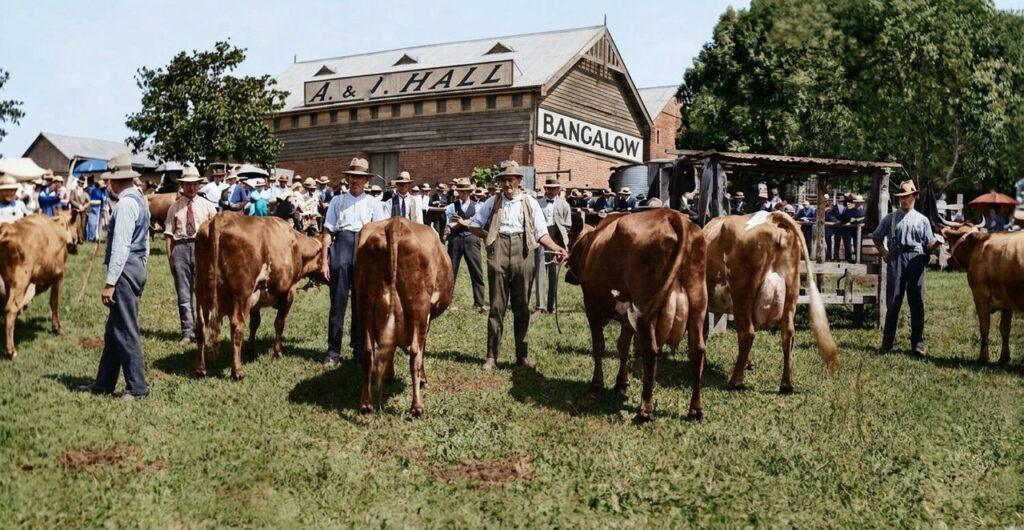
The cattle section was undoubtedly a principal attraction, reflecting the growing importance of dairying to the prosperity of the Richmond River. Mr D. Cooke secured the coveted champion bull award, while Mr J. T. Young took the honours for champion cow, with Johnston Brothers receiving the reserve award.
Mr Young also distinguished himself in the butter-fat competition, his cow Ethel securing first prize for the greatest quantity of butter yielded in a single milking. Ethel produced 27lb of milk, with a butter-fat test of 4.1, yielding 1.107lb of butter.
Mr Cooke’s Beauty and Fancy followed in the placings, demonstrating the quality of the district’s dairy herds.
The judging was no mere matter of appearance. Milk yields and butter-fat tests are assuming increasing importance, as farmers seek not only handsome cattle but animals capable of providing profitable returns.
Among the younger stock, Mr Joseph Akers took first prize for a milking heifer aged two and under three years, while Fredericks Brothers secured the first two places in the corresponding dry-heifer class. Mr A. Kirkland won the class for heifers aged one and under two years, and Mr John Hayter secured first prize for a heifer calf under 12 months.
A bullock, a sewing machine and a remarkable guess
Among the lighter diversions, the Fat Bullock weight-guessing competition attracted considerable interest, with a Singer sewing machine offered as the prize.
Mr A. Kirkland of Pearces Creek proved himself an extraordinarily accurate judge of livestock, estimating the animal’s weight at precisely 819lb. Messrs W. McCormack of Federal and J. C. Noble of Newrybar were scarcely less successful, each submitting a guess of 819½lb and dividing the second and third honours.
The competition realised the handsome sum of £28 for the Society.
Nor was the public’s skill at estimation exhausted. A bottle containing 1,275 grains of corn was the subject of another contest, won by Mr Fred Lee of Bangalow, whose guess was exactly correct. A further £10 6s was raised for the Society.
Fine horses and accomplished riders
The horse section provided another lively attraction, with fine animals exhibited in the buggy, hackney, trotting and hunter classes.
Mr W. Taylor enjoyed particular success, taking the champion hackney award and the prize for the best all-round horse. Mr J.Johnston was successful with his family buggy horse, while Mr J. Noble took first prize in the light buggy horse class. Mr W. Rankin secured the award for a buggy pair.
The ladies also demonstrated their considerable skill in the saddle. In the lady rider competition, Mrs A. Moles and Miss Navin divided the honours, while Miss Armstrong secured first place in the hunter class, ahead of Mr A. Moles and Mr R. H. Walker. Such contests are always watched with interest, for the ability to manage a spirited horse with confidence and grace is no small accomplishment.
A difference of opinion among the pigs
The pig section supplied its own cause for discussion, particularly in the competition for the four-guinea special prize awarded to the best pen of bacon pigs exhibited by a bona fide farmer.
Mr Cameron secured the prize with three remarkably fat and even animals. Not all spectators, however, were satisfied with the judges’ decision. Some maintained that another pen was more deserving, the winning pigs being considered altogether too fat.
It seems that even among prize pigs, one may have too much of a good thing.
Mr S. D. Caines exhibited a fine Tamworth boar, which secured championship honours, while his Berkshire sow was also much admired. The poultry section offered further attractions, particularly among the Silver Wyandottes, whose handsome markings and fine development drew favourable comment.
The fruits of the district
Away from the livestock, the farm and dairy produce exhibits provided further evidence of the richness of the surrounding country.
The fruit and vegetable prizes were shared among a number of exhibitors, including Mrs G. R. Powell and Messrs F. Wareham, G. Johnson, T. Kirkland, A. Warne and J. Armstrong.
The Byron Bay Co-operative Company distinguished itself in the dairy produce section, securing prizes for butter intended for both the local market and export, as well as presenting a commendable exhibit of bacon and hams.
Within the pavilion, the domestic and decorative exhibits provided their own attractions, offering an opportunity for the skill and industry of the womenfolk of local households to be recognised alongside the achievements of the district’s farmers.
Good company and high praise
The Society’s luncheon afforded an opportunity for visitors and local gentlemen to exchange compliments upon the quality of the district’s livestock.
Mr R. Campbell, President of the Society, presided, with toasts offered to the King, the judges, neighbouring agricultural societies and visitors.
The luncheon was of a substantial character, with good things in abundance and a convivial atmosphere. Guests dined on cold corned beef and pressed tongue with fresh bread butter and mustard, followed by roast mutton with boiled potatoes and cabbage. The assembled gentlemen appeared to do full justice to the fare and thanked the ladies of the committee for their hospitality.
Visiting judges spoke in glowing terms of the dairy cattle, several declaring them equal to, if not superior to, those encountered elsewhere.
Mr W. Stephens, a Queensland visitor and experienced cattle breeder, expressed astonishment at the number of dairy cows assembled on one showground. He also offered practical advice concerning cattle ticks, warning that farmers should not suppose the border would keep the pest at bay indefinitely.
It is to be hoped that the district’s cattle breeders will continue to prosper without the unwelcome assistance of such visitors.
At the conclusion of the luncheon, small sweet tartlets and fancies demostrating the cookery skills of the district’s women were served with a liberal supply of tea.
A promising future
The importance of the Bangalow Show extends well beyond the awarding of prizes. It is an occasion upon which farmers may compare their stock, exchange knowledge and observe improvements in breeding and agricultural practice, while residents of Bangalow and neighbouring settlements gather in a spirit of friendly rivalry.
Wednesday’s rain undoubtedly deprived the exhibition of some of the success that might otherwise have attended it, but it could not diminish the quality of the exhibits or the enthusiasm of those responsible for their preparation.
Bangalow may still be a comparatively young agricultural centre, but its farmers have demonstrated that they need yield little to their more established neighbours.
And if this year’s exhibition is any indication, the Society may look forward to many more successful gatherings, with finer cattle, faster horses and perhaps another gentleman capable of guessing the exact weight of a bullock.
L. M. Carpenter
* An imaginative reconstruction of the fifth annual Bangalow Agricultural Show, 5–6 March 1901, created from newspaper records from the day.