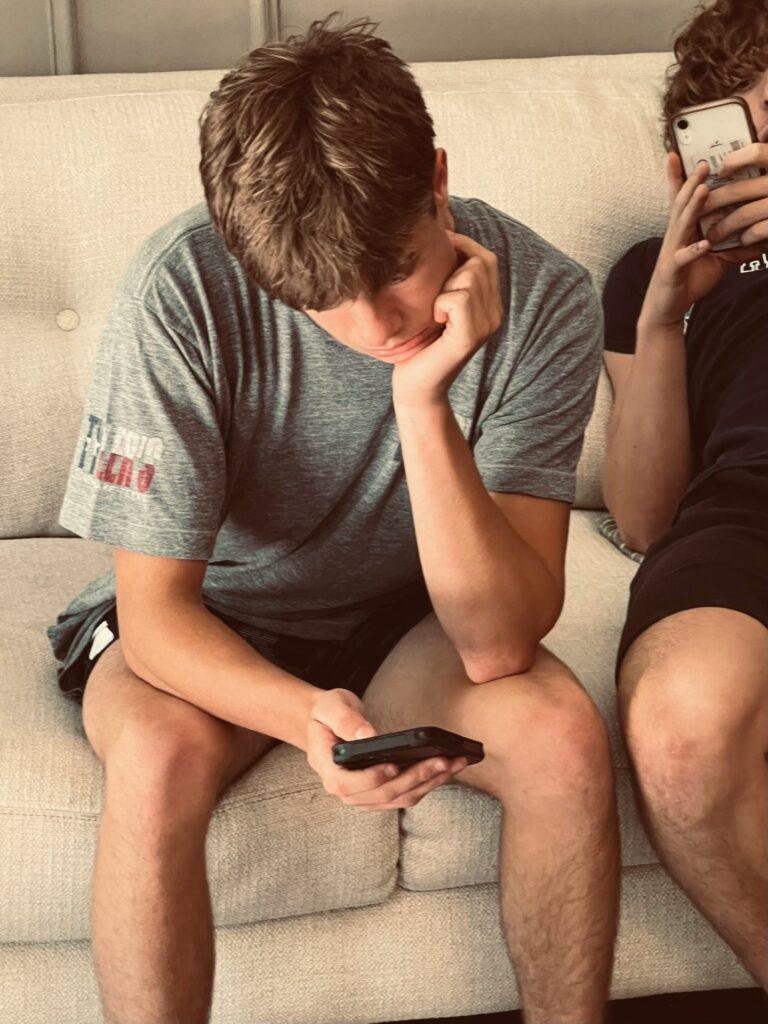
The Herald’s newest – and youngest recruit – 14-year-old Charlotte Burns, chats with local young teens about the effects of the Federal Government’s social media age restrictions for under 16s.
A few months ago, the “ping” of a TikTok notification or a Snapchat streak was the heartbeat of our social lives. Since the Federal Government’s ban on under-16s accessing certain social media platforms hit the headlines, the adults have done most of the talking.
But what about the people actually living through it? As someone who falls into this age bracket, I wanted to go beyond politics and see how the ban is changing the day-to-day lives of my peers. Did teenage life really change? Have the so-called “addictive” apps become non-existent for everyone under the age of 16, or are adults imagining a bigger shift than what is actually happening? I caught up with 10 of my contemporaries to talk about their “old” habits, their first reaction to the news, and what they’ve gained or lost since the ban came into effect.
For some students, the ban barely registered as a major change. Jake (15) explained that social media was never central to his routine. He mainly used his phone for communicating with his friends, learning gym routines and looking at recipes, and said he “didn’t really care” when the ban was introduced because he didn’t use any of the restricted apps. Jake continues to communicate through WhatsApp and normal messaging, demonstrating that for some teenagers, friendships were never dependent on traditional social media platforms in the first place.
Others experienced the ban more negatively. Brooke (15) said she “spent quite a lot of time” on Instagram before the restrictions began, originally using it to stay connected with friends before becoming absorbed in trends and entertainment. Although she felt “shocked” when she heard the news, she also stated that she “completely understood why it was being enforced”. She believes the policy fell flat in its implementation, explaining that “most people my age found easy ways around it”.
Banjo (14) offered a more positive perspective. Before the ban, he mainly used WhatsApp and YouTube to organise plans and stay included socially. Unlike expectations that teenagers would strongly resist the change, Banjo said he was “pretty happy” when he first heard about the restrictions because he believed they could help people step away from social media addiction and participate more in real life. While his own routine did not change dramatically, he noticed friends spending less time scrolling and more time communicating through group chats instead of social media.
Despite the intention of the ban, several teenagers said enforcement had been difficult. Some had created new accounts or moved to different platforms. Banjo supported this idea, noting that “people are leaving Snapchat and TikTok etc. and participating more in real life”, but added that “the ban isn’t working as effectively as it should, and many kids are still on social media from my experience”. Similarly, Brooke suggested the policy had changed access rather than stopped usage.
Sadie (14) described a very different experience. As a frequent social media user, using the platforms “every chance I could get”, Sadie relied on TikTok, YouTube and Instagram for entertainment and connection. She said she felt “very annoyed” when the restrictions were announced, worried about missing out socially. Although she sometimes felt on the “outside” of friend groups after losing complete access to shared trends, she also noticed unexpected positives. Like Willow (13), who supports the ban despite never having social media, Sadie observed friends communicating more face to face and found herself watching more shows and even reading more books, something she “would never expect” from herself.
Koa (13) and Tyrese (13) revealed how varied teenage experiences have been at the younger end of the age bracket. Koa had not engaged with social media before the ban due to parental rules but said it made him “more determined to get on social media” after his friends demonstrated ways around it, arguing the policy was “not well thought through”. In contrast, for Tyrese, who uses Snapchat and TikTok to talk to friends, the ban made little difference. He said that “nothing happened to me” when it came into effect. Their experiences show that for some the ban backfired by fuelling curiosity, while others simply didn’t care about the age restrictions.
One interesting pattern that became evident from the interviews was that many teenagers had restrictions in place at home before the official ban. Several respondents said their parents had already had a big influence on their activity, setting rules around phone use, app downloads and device access. As Jake says: “I didn’t lose anything because I only recently got a phone at 14,” which indicates that some teens were only just beginning to build phone habits anyway. Across the board, it seemed that younger teens were receiving phones later than their older siblings. Overall, it appears that parental control, specifically monitoring phone access, has shaped teens’ experiences more than the legislation itself.
Since the ban came into effect, it’s clear that social media was more than just an assortment of apps on a phone; it shaped how we stayed connected, shared our lives and filled in the gaps of everyday conversation. Across all interviews, a clear pattern emerged. While adults often described the ban as a dramatic shift in teenage culture, many young people simply adapted. For some, the change has felt frustrating and sudden, while for others it has brought unexpected positives such as more face-to-face time and less pressure online. Meanwhile, many teens were unaffected due to parental policies already in place.
From the data, it’s clear the teens who have lost access do want it back. However, what is more telling is that parents are more alert, aware and protective of their children. So the question arises: was the ban for the benefit of teenagers, or was it more of an educational wake-up call to parents?